



At what point will layoffs in 2026 stop being news? According to a survey by LHH, a unit of Adecco Group, 87% of HR leaders expect more mass layoffs this year. If anything, it looks like we’re in the middle of a never-ending surgical nightmare.
Somewhere along the way, job cuts have stopped operating as a drastic measure to turn things around and swiftly become a beloved management tool. The mass influx of headlines reporting layoffs in 2026 suggests workforce reductions are now treated like an inventory.

Only 19% of employees know about redeployment programs that 77% of HR leaders insist exist.
Businesses that once claimed ‘people are our greatest asset’ are the ones leading the great divide between those who received the pink slip and the ones who wonder if they’re next.
HR Leaders expect more layoffs in 2026 as job cuts become business as usual
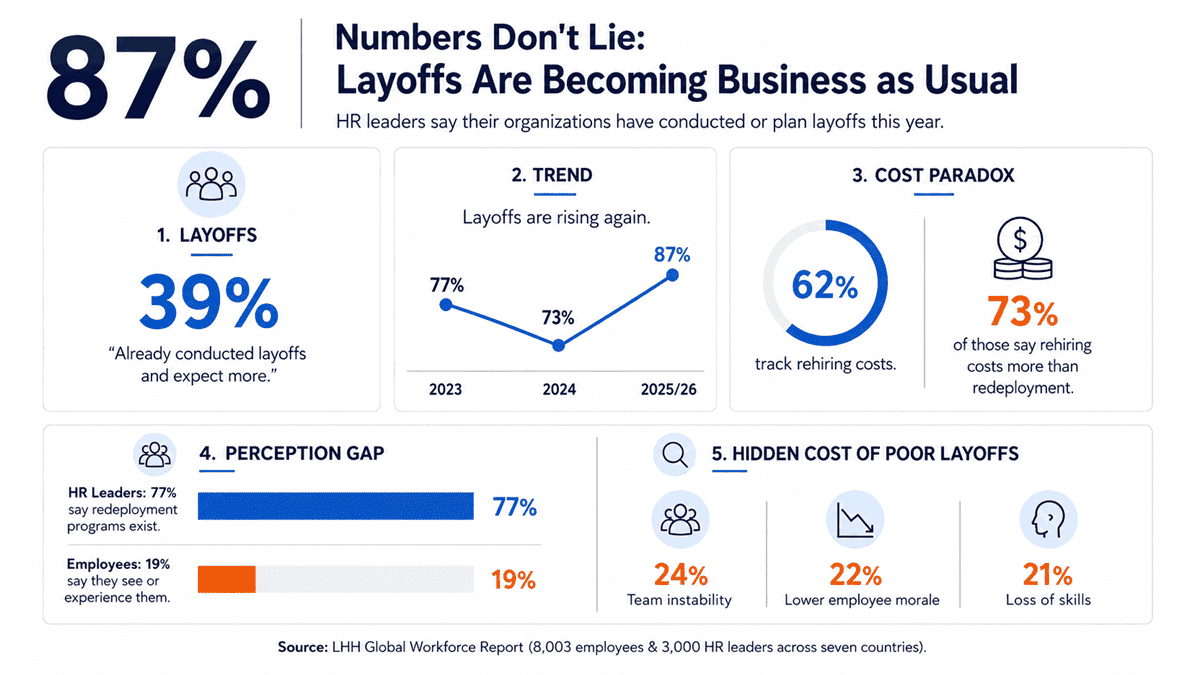
A majority of HR leaders globally (87 percent) reported that their organizations have already conducted or are planning layoffs this year. Roughly 39% of HR leaders have already cut roles and expect more reductions ahead.
The share marks an increase from 73% in 2024 and 77% in 2023.
(Infographic: THE HR DIGEST)
What’s worth nothing is that despite the prevalent of layoffs, many organizations lack visibility into the financial tradeoffs of such restructuring. According to the survey, 62% of employers track rehiring costs, nearly three-quarters of those said rehiring is more expensive than targeted redeployment and internal transfers. However, only 32% measure cost savings tied to redeployment strategies and 30% track the number of redeployments.
“Layoffs are a necessary part of how organizations adapt to shifting skills demands and market realities. The question is whether companies have the infrastructure to identify which talent to redeploy for future needs and which to support through high-quality outplacement,” John Morgan, president of career transition mobility at LHH, said in a press release.
There’s a widening perception gap among HR leaders. Around 77% of HR leaders reported they offer targeted redeployment and mobility programs. Only 19% of employees said they recognize or experience such programs.
When it comes to HR leaders who track rehiring costs, 73% said the fire-and-rehire cycle is far more expensive than redeployment. 24% of HR leaders recognize that poorly managed transitions lead to team instability, while 22% reported reduced employee morale and 21% cited lost skills.
Mass layoffs are reshaping mental well-being
(Infographic: THE HR DIGEST)
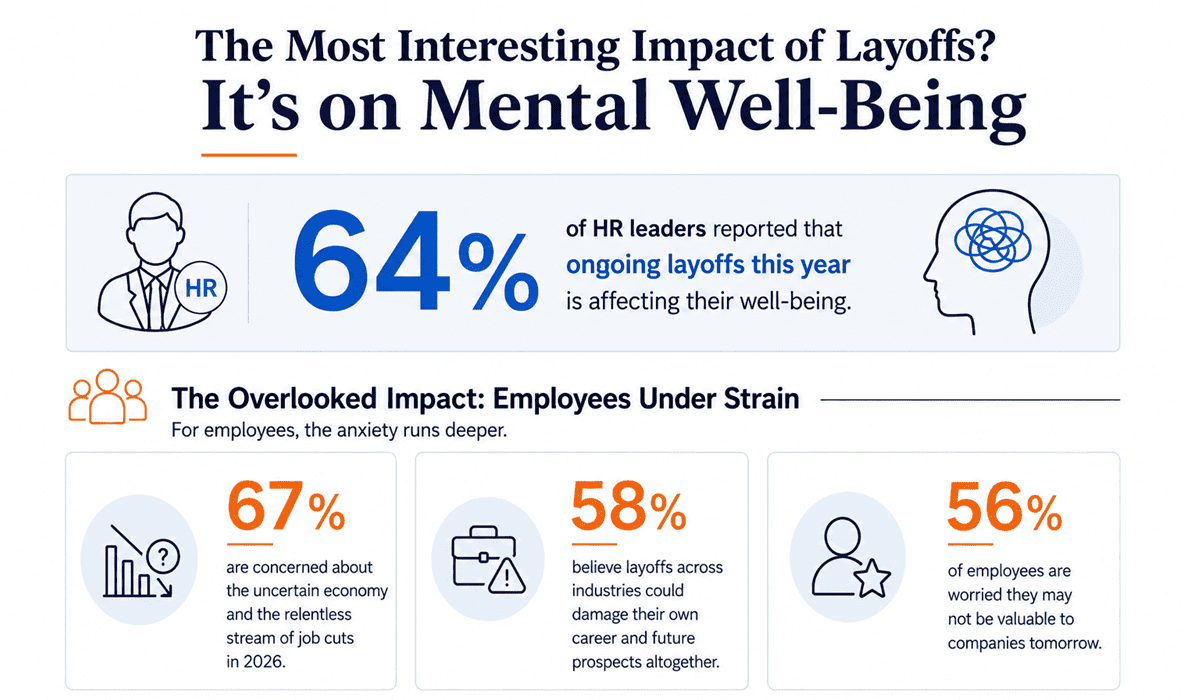
The most interesting aspect of layoffs is how it affects mental well-being of leaders. 64% of HR leaders reported that ongoing layoffs this year is affecting their well-being.
The most overlooked aspect remains the well-being of employees under such strain. For employees, the anxiety runs deeper. Roughly 67% are concerned about the uncertain economy and the relentless stream of job cuts in 2026.
This fear has become personal as 58% believe layoffs across industries could damage their own career and future prospects altogether. Skills have become a source of anxiety as well. 56% of employees are worried they may not be valuable to companies tomorrow.
Adam Grant, one of the most renowned organizational psychologists of our times, has put it best. “Uncertainty is often more stressful than bad news,” he wrote. “When people don’t know what’s coming, they imagine the worst.”
Most companies are chasing skills
(Infographic: THE HR DIGEST)
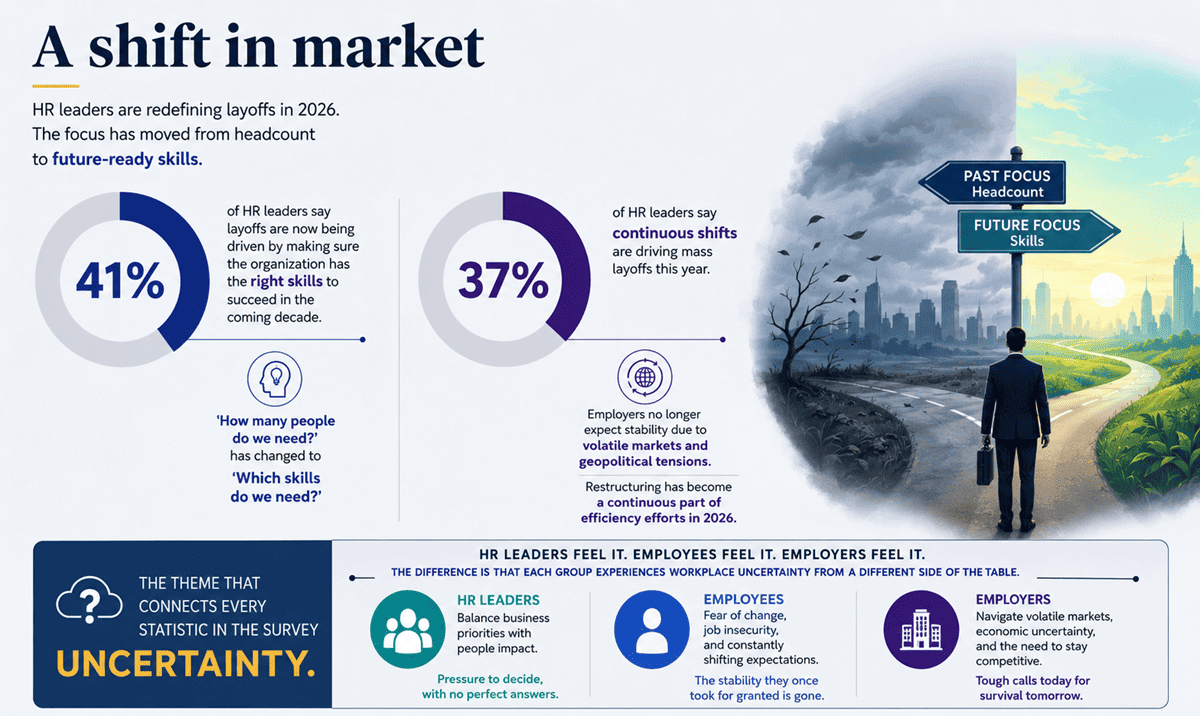
According to the survey, 41% of HR leaders say layoffs are now being driven by making sure the organization has the right skills to succeed in the coming decade. This changes the conversation we’ve had in the past from ‘how many people do we need?’ to ‘which skills do we need?’
Another 37% of HR leaders say the continuous shifts are driving mass layoffs this year. Employers are no longer expecting stability due to volatile markets and geopolitical tensions. Restructuring has become a continuous part of efficiency efforts in 2026.
There’s one particular theme that connects every statistic in the survey. And it is uncertainty. HR leaders feel it, so do employees and employers. The difference is that each group experiences workplace uncertainty from a different side of the table.
Over the past two years, major employers across technology, finance, retail, and manufacturing have repeatedly announced mass layoffs. The pattern suggests workforce reductions are increasingly being used as an ongoing strategy rather than a last resort to succeed in the next quarter.
NOTE: The report surveyed 8,003 white-collar employees and 3,000 HR leaders across the U.S., Canada, Switzerland, France, Brazil, Australia and the U.K, focusing on companies with more than 500 employees.
Subscribe to The HR Digest and join our inner circle of HR leaders who stay ahead of the curve.
