The second most asked question after “Who is responsible for completing the I-9 form?” is, as it turns out, “Are I-9 forms required for all employees?”. The world of HR is nuanced when it comes to compliance, and in this column, our resident HR advisor, Jane Harper will answer .
But, first things first…
What is an I-9 Form?
An I-9 Form (Employment Eligibility Verification) is an official U.S. government document issued by USCIS. All U.S. employers must use the I-9 Form for employees to verify the identity and legal work authorization of every new employee they hire within the company. Form I-9s are a must for both, citizens and noncitizens and present valid physical or digital identification documents.
How does the I-9 process work?
Here is where things get complicated as both the employer and employees are involved in the I-9 process.
Section 1: It’s for employees, and the Form I-9 must be completed by the worker no later than their first day of work. The employee needs to fill out their legal name, address, date of birth, and citizenship status, and then sign it.
Section 2: This section of the Form 1-9 must be completed by the employer or authorized representative within three business days of the employee’s start date. The employer must physically or remotely examine and verify original identification documents on the List A, List B and List C provided by the employee.
What is List A, List B and List C of the Form I-9 process for employees?
Lists A, B, and C are three different categories of identification documents used for the U.S. Citizenship and Immigration Services (USCIS) Form I-9 to verify an employee’s identity and work authorization. An employee is required to provide either one selection from List A or one selection from List B along with one selection from List C.
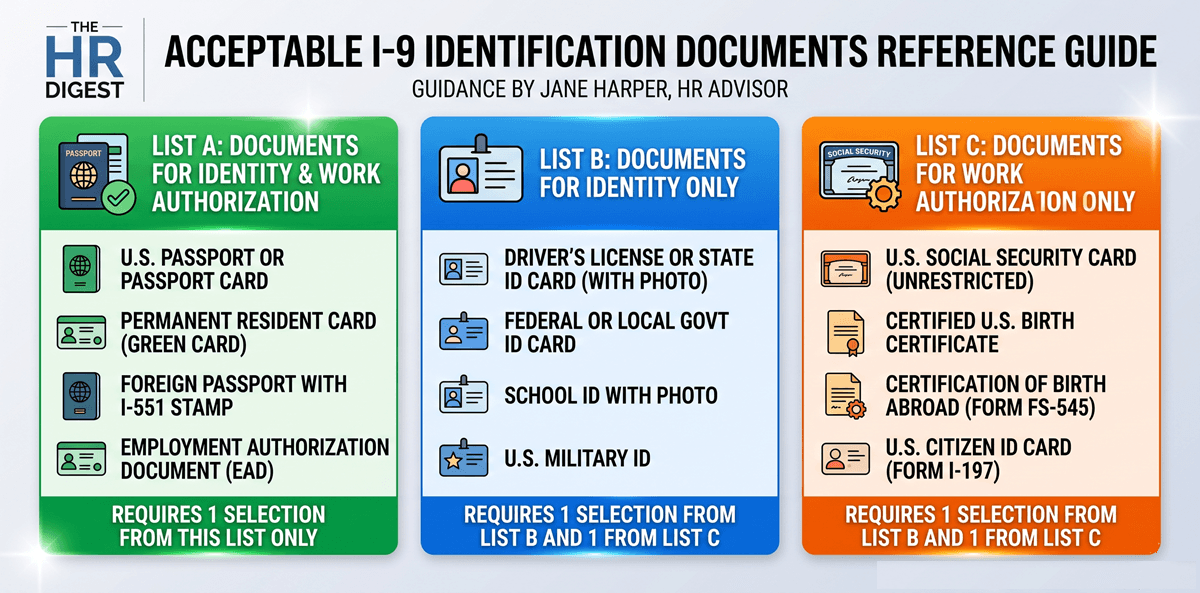
List A for Identity and Work Authorization
List A of the Form I-9 process requires documents like a U.S. Passport or Permanent Resident Card (Green Card).
List B for Identity Only
List B of the Form I-9 process requires employees to submit documents like a driver’s license or state ID card.
List C for Work Authorization Only
It requires a Social Security card or U.S. birth certificate.
Note: If an employee doesn’t have a List A document, they are required to present one item from List B and one item from List C for the Form I-9 process.
What happens if an employee doesn’t have an I-9?
If an employee does not have a completed Form I-9, the employer may face direct legal or financial liability under Federal Law. Furthermore, the employee risks termination of employee if they fail to provide the required identity and work-authorization documents within three business days of hire.
Consequences For Employers
Employers can face government fines from U.S. Immigration and Customs Enforcement (ICE) for missing, late or incorrectly filled I-9 forms. Missing forms during a government audit are treated as unverified hires, which can escalate to civil money penalties or charges for hiring unauthorized aliens.
Consequences For employees
If an employee refuses or fails to provide acceptable verification documents within the legal timeframe (usually three business days), the employer must terminate them from the job. While no fines are levied on employees for failing to produce acceptable documents for the Form I-9 verification process, the lack of completion disrupts their legal status on the job.
Are I-9 Forms required for all employees?
As it turns out, Form I-9 is required for every single new hire in the United States, including both U.S. citizens and non-citizens. Employers are required to complete a form for every newly hired individual, whether they work full-time or part-time. This requirement applies regardless of whether the employee is a U.S. citizen. Employees are required to finish Section 1 by the end of their first day of work, and employers must review the employee’s original documents and complete Section 2 within three business days of the hire.
Note: Independent contractors, volunteers, casual domestic workers and employers hired on or before November 6, 1986 aren’t required to fill out Form I-9 for verification.
Common I-9 Mistakes to Avoid
Form I-9 errors can lead to serious consequences such as heavy penalties and termination of employment. Civil fines for paperwork violations could range from hundreds of thousands of dollars per form. Furthermore, any issue uncovered during an ICE inspection can lead to reputational damage and increased scrutiny.
Here are some Form I-9 errors to avoid for employers
An employee might forget to sign or date the form. It’s a must that Section 1 of the Form I-9 be completed on or before the employee’s first day of employment.
It’s easy for employees to skip selecting the appropriate citizenship status, not including an expiration date of their employment authorization or making typos in the fields. Employers must ensure each field of the Form I-9 is filled correctly.
When it comes to Form I-9, compliance isn’t enough. A minor mistake can turn into major penalties. But the good news is that with a little diligence, you can stay ahead of the curve.