



It is said that every geography tells it owns story. What if it’s a glaring story of economic instability, inflation and mass layoffs in 2026? Of the global job cuts tracked so far, the U.S. accounts for 121,072 tech layoffs in 2026, dwarfing all other nations. If workforce reductions are the new global language, then U.S. companies, it seems is writing its most consequential chapter in the history of employment.
One particular company’s restructuring journey accounts for a remarkable share of tech layoffs in 2026. Oracle is responsible for 19.5% of all tech job cuts in 2026, making it the single biggest contributor to this year’s workforce reductions.
Oracle acknowledged in its annual filing that AI deployment had replaced a large number of jobs and warned that future layoffs could follow as internal AI adoption expands.
A few familiar names from last year appear behind the long shadow left by Oracle. Microsoft, Intel, Amazon, Meta, Autodesk, CrowdStrike, Block, Blue Origin and Chegg have all earned notoriety for announcing mass layoffs in tech, suggesting this is an industry-wide recalibration to overcome AI distress.
Behind every job cut in tech is an AI investment tailing for a leaner, faster future.
Tech Industry Leaders remain unimmune to mass layoffs in 2026

Tech layoffs in 2026 reveal a greater imbalance: 121,072 job cuts in the US., compared with 4,491 in Australia, 3,286 in Israel and 2,577 in India.
“AI is changing how work gets done,” wrote Amy Coleman, Microsoft EVP and Chief People Officer in a memo announcing layoffs on July 6, 2026. Microsoft layoffs affected 2.1% of the company’s workforce – 4,800 roles were eliminated. “Some of the tasks we do every day can now be automated, and that means we all need to keep learning, keep building new skills, and keep adapting as the work evolves.”
Intel chose retrenchment mode by continuing workforce reductions that The HR Digest was the first to report in 2025. The chipmaker is pushing all boundaries to streamline operations and restore profitability after years of manufacturing delays and fierce competition from rivals.
Amazon, it appears, is busy pruning middle management despite continued AI expansion. The world’s largest e-tailer is aggressively recruiting AI researchers, robotics specialists, and cloud engineers, while announcing mass job cuts across other divisions. It’s one of the rare few behemoths in Silicon Valley which has successfully demonstrated that today’s layoffs can coexist with significant hiring.
Meta’s reappearance in the news cycle for mass tech job cuts in 2026 suggests layoffs are now a part of the company’s operating rhythm. “We miscalculated,” CEO Mark Zuckerberg acknowledged that Meta’s AI expansion had not progressed as quickly as leadership expected. The company returned to strong revenue growth but is still reorganizing teams, consolidating projected and redirecting resources towards Zuckerberg’s ambition of world’s biggest AI expansion.
Autodesk’s layoffs in 2026 reflect a common theme across the industry. Companies are now trimming fluff to free up investment for AI products, cloud capabilities, and long-term growth initiatives.
The reinvention wheel spins after tech job cuts in 2026
Traditionally, the commercial space industry has been associated with bold expansion and ambitious hiring, even if it comes in the form of poaching. But, Blue Origin’s layoffs in 2026 signaled that even space companies are embracing financial discipline and scaling back where resources don’t meet business priorities. Limitless hiring, it seems, is a story of the past.
“Companies move fast or slow based on information flow. Hierarchy and middle management impede information flow.”
– Jack Dorsey, CEO of Block, and Roelof Botha, Managing Partner at Sequoia Capital, on why tech companies are flattening management structures.
Cybersecurity remains one of tech industry’s fastest growing sectors, yet Crowdstrike layoffs in 2026 reduced that notion to rubble. The job cuts show that high demand alone no longer guarantees workforce stability. Today’s companies are reassessing organizational structures and prioritizing profitability alongside innovation, and Crowdstrike is leading the bunch.
Block continues CEO Jack Dorsey’s darling philosophy of building smaller but running faster. Rather than treating layoffs as a casualty, Block has repeatedly embraced job cuts in 2026 to simplify operations and improve efficiency.
“Companies move fast or slow based on information flow,” Block’s top executive, Jack Dorsey, and the venture capitalist Roelof Botha wrote in a lengthy blog post cautioning that more job cuts are come in 2026. “Hierarchy and middle management impede information flow.”
Once a dominant name in education, Chegg has repeatedly reduced its workforce with mass job cuts in 2026 as students increasingly turn to generative AI tools instead of traditional homework-help platforms. Unlike Silicon Valley leaders using AI to improve efficiency, Chegg is confronting a more existential challenge. AI has altered customer behavior, forcing the education leader to rethink its business model.
The language of tech layoffs in 2026 remains elegant
It’s worth noting that traditional words like ‘layoff’ and ‘job cuts’ are disappearing from corporate announcements. Companies are now seeking emotional cushion by using words like “strategic realignment,” “workforce optimization,” “organizational simplification,” and “future readiness.”
Microsoft’s layoffs were termed as an effort to adapt to how AI is changing work. Job cuts at Oracle were framed as restructuring around future investments in cloud and AI infrastructure. Intel has repeatedly tied layoffs in 2025 and 2026 as measures to improve operational efficiency, while Meta’s job cuts continue to emphasize on organizational agility.
The vocabulary has become as important as the tech layoffs themselves. What was once described as downsizing is now presented as a much-needed transformation with gentle narration.
What comes after tech layoffs of 2026? More job cuts?
Statistics, delightful as they are, have a curious way of revealing truths that headlines alone cannot. In 2026, the United States has recorded 121,072 tech layoffs, a number that towers over Australia’s 4,491, Israel’s 3,286 and India’s 2,577 job cuts. It is a reminder that while the tremors of restructuring are felt across the globe, the center of tech layoffs in 2026 remains to be America.
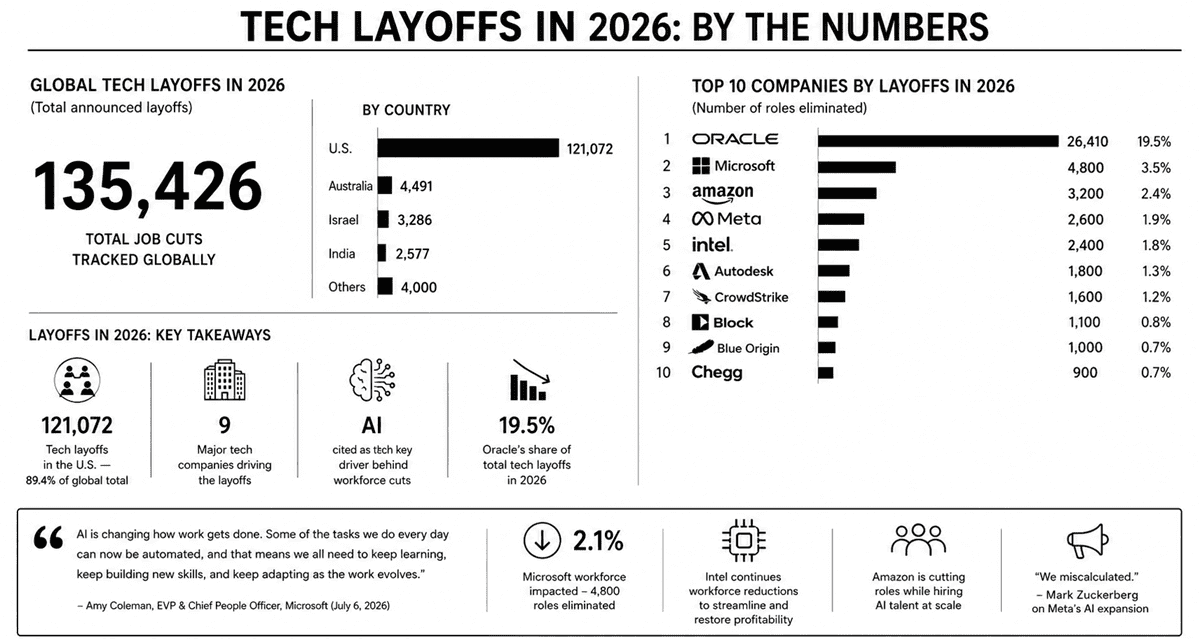
Oracle leads the pack with 19.5% of all tracked tech layoffs of 2026, while Microsoft, Amazon, Meta, Intel and others show an industry-wide shift toward AI-led restructuring. (Infographic: The HR Digest)
What is fascinating is that tech companies share little beyond their willingness to trim payrolls. Oracle is busy building a leaner enterprise software company. Microsoft is betting its future on AI. Intel is reinventing semiconductor manufacturing and Amazon spans everything from cloud computing to logistics. Some dreams are not hard to catch it seems if you undertake layoffs. Meta continues chasing AI expansion, Blue Origin drops a few recruits from its workforce, and Chegg returns to its promise of democratizing education with job cuts.
It’s different sectors, different ambitions and different boardrooms, yet all seem to arrive at the same conclusion.
Perhaps, the defining feature of 2026 is not the number of mass layoffs in tech but the philosophy behind disappearing jobs. And for millions of workers, that may prove to the only hurdle.
Subscribe to The HR Digest and join our inner circle of HR leaders who stay ahead of the curve.
